
Visual Thinking for Language Teachers: A Glossary of Graphic Facilitation, Sketchnoting & More
What is the difference between graphic recording, graphic facilitation, sketchnoting and visual thinking?
Visual thinking can help support our learners to process information, understand and remember. However, there are a lot of different key terms which can be tricky for us teachers to get our heads around.
As an English language teaching professional who brings visual magic to classrooms around the world, I'd like to clarify some of these words and phrases.
In this blog post, I'll explore some of the most popular aspects of visual thinking for language learners.
A Sketchnote To Explain Visual Thinking Terms
As we all know, a visual can express 1000+ words, reduce processing load and help us access information quickly.
So I created this sketchnote to summarise some of the common visual thinking terms:
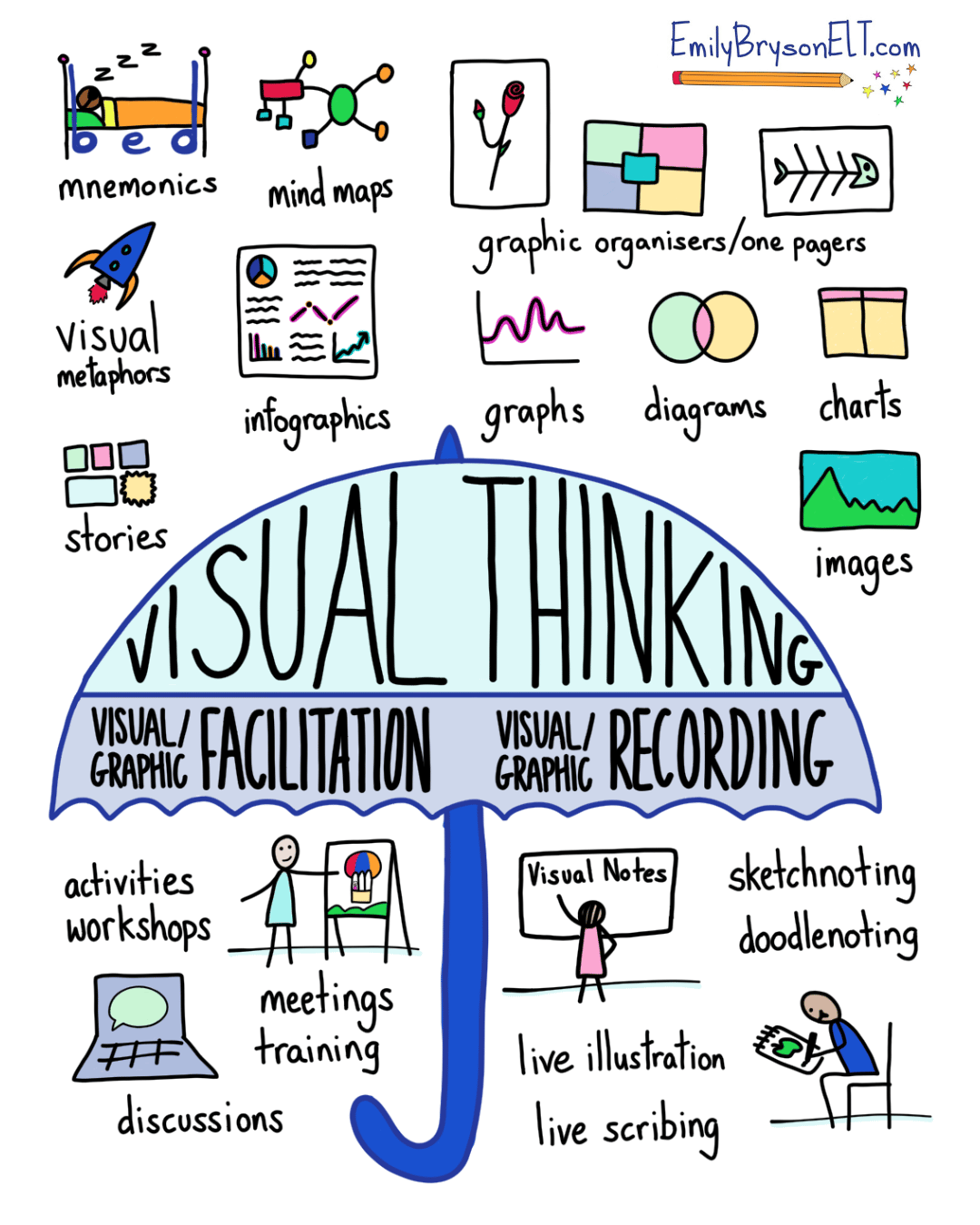
What is Visual Thinking?
In many ways, visual thinking is an umbrella term for using graphics to think..
It utilises a range of multi-sensory techniques such as mind-mapping, diagrams, images, infographics, sketchnotes, doodling and visual metaphors.
These activities help people to think about complex problems from different perspectives. They can support the process of connecting information, categorising, analysing and re-framing.
From a language teaching perspective, learners can show that they have understood by creating and sharing their own visual, or interacting with a task using post-its, tables or posters.
What is Visual / Graphic Facilitation?
The terms graphic recording and facilitation are often used inter-changeably. Different people interpret them in different ways.
The word 'facilitation' is the process of making things simpler. It has Latin roots. For example, in Spanish 'más fácil' means 'easier'. So, technically, graphic facilitation means making things easier with visuals.
Graphic or visual facilitation has it's roots in the meeting room. It is often used to help organisations solve problems, share ideas and design products.
From a classroom perspective, facilitation refers to the process of guiding participants through a learning experience. The teacher is a facilitator, who uses a range or graphic activities, tasks and strategies to get students discussing, exploring and studying.
I personally like to think of graphic facilitation as using visuals for workshops, webinars or teaching.
Here are some blog and social posts I've written with examples of graphic facilitation:
What is Visual / Graphic Recording?
Graphic or visual recording is the process of listening, interpreting information and creating a visual summary of the key takeaways.
There are many different terms for this. I'll address each one individually:
Visual / Graphic Recording
For me, this is the umbrella term for taking notes with graphics.
Graphic or visual recorders (such as myself) are commissioned to create professional hand drawn notes at workshops, webinars and conferences. These notes can then be shared by participants and serve as a lasting reminder of an awesome event.
Live Illustration / Live Scribing
Graphic recording can take place behind the scenes, with the visual recorder quietly doodling away, then sharing their notes after the session has finished. .
It can also take place live, as part of the magic of the event. A live illustrator or live scriber can share their screen so that participants can see them drawing out their notes as the speakers speak.
Here's an example video of me doing this at a Macmillan Fast Forward event. The speakers were reviewing top teaching ideas from their previous webinars. My role was to create visuals to represent each one.
You can access the finished visual notes (sketchnotes) here:
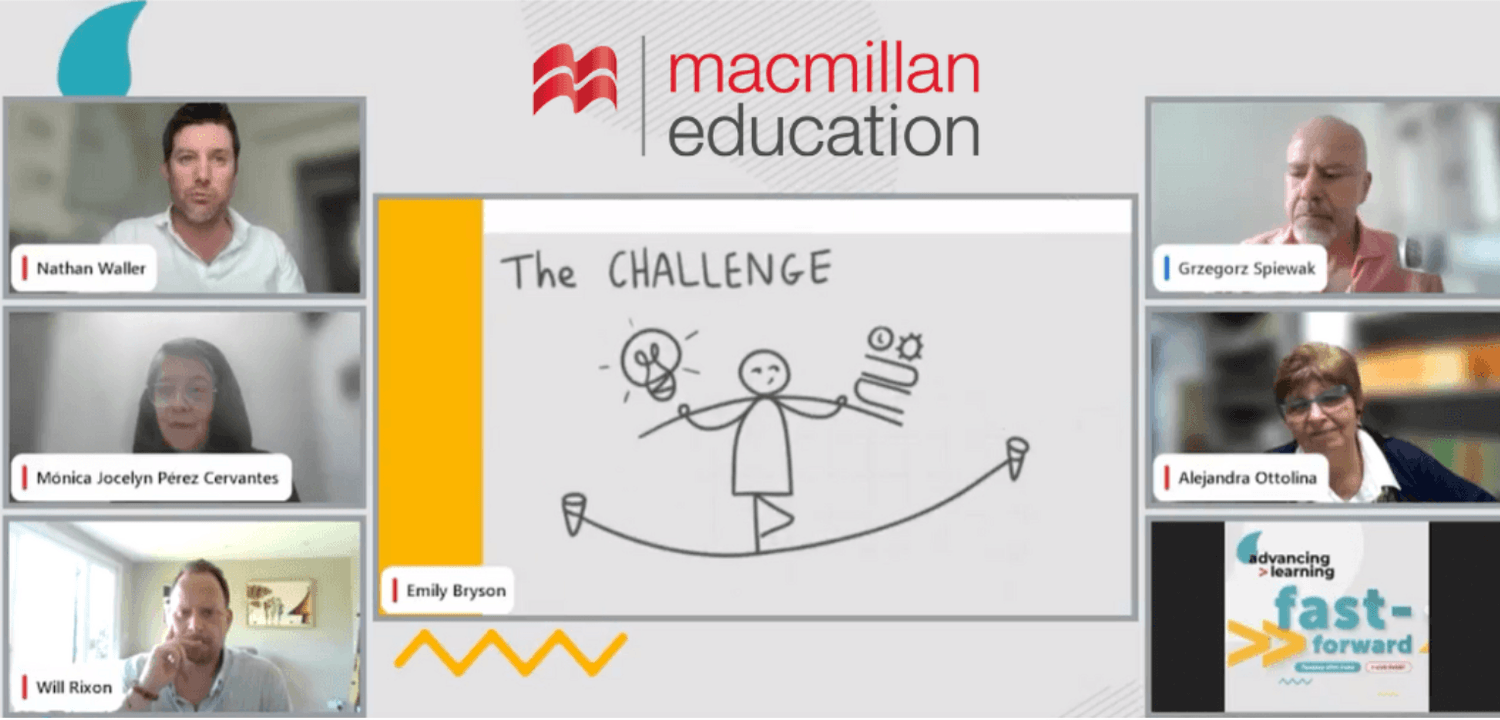
Live illustration in many ways is a performance. It can also involve creating a large scale summary of the event.
Here's me creating one on a whiteboard at the NATECLA. ESOL conference in Birmingham.
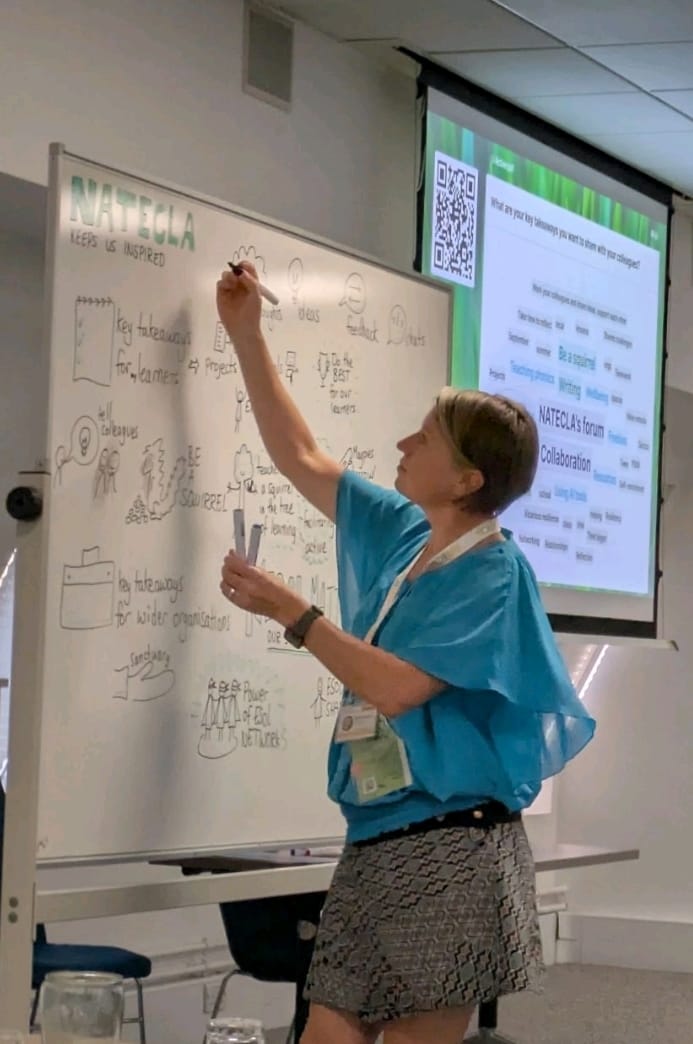
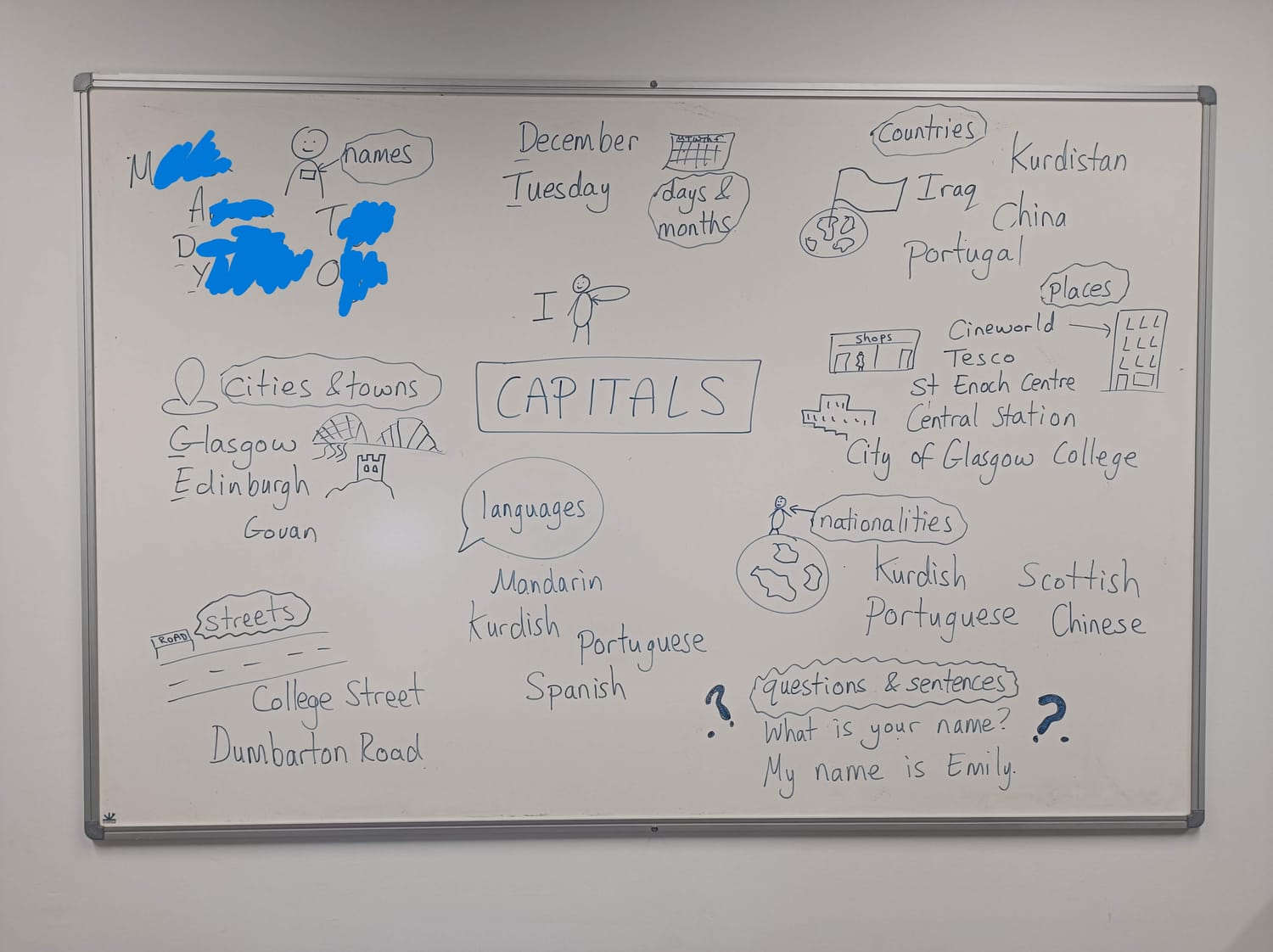
This can be a fun skill to have in the language classroom. It can make your whiteboards more accessible, engaging and fun. It can also inspire learners to copy your simple doodles to their notebooks.
Here's an example whiteboard that I created one day when my learnrs were exploring different ways to use capital letters.
Click the image if you want to explore my courses and try this teaching technique.
Sketchnoting / Visual Note Taking
Sketchnoting and visual note taking both involve taking notes with simple doodles. They are a great way to listen deeply, focus and come to an understanding of the content.
As with many of the terms we're exploring in this post, sketchnoting and visual note taking can be used inetrchangeably with visual or graphic recording.
My interpretation would be that sketchnoting is more informal. Graphic or visual recorders get paid to create professional visual notes. Sketchnoting on the other may be more for personal pleasure or learning.
However, sketchnoting and visual note taking are also simpler, more well-known terms - so I often use them to refer to my professional note taking services.
Doodle Noting
Taking notes with simple doodles isn't about creating art. It's about trying different ways to learn, think and remember. It's an opportunity to make notes that implant themselves in the memory and that make people want to revise. It's not about perfection, but instead can be messy, quick and unrefined.
In my pursuit of making sketchnoting accessible to language tecahers and learners, I often ponder whether sketchnoting is unneccesarilly intimidating. Sketching suggests a quick drawing, but it also suggests the use of artistic techniques such as shading, tone and depth.
As sketchnoting is about creating quick, hand drawn icons to represent ideas, perhaps it would be better to call is doodlenoting? I know a few people who refer to it this way.
What do these visual thinking terms mean to you?
Everyone is different and creates their own meaning from the knowledge, skills and experience that they have.
What do these terms mean to you? I'd love to know your own interpretations.
For more on this topic, check out my online courses, freebies, resource packs, training, sketchnoting services and blogs.
Visual Thinking to Make Learning Accessible, Engaging & FUN,
I'm Emily Bryson, an English Language Teaching Specialist who brings visual thinking sparkle to classrooms around the world.
I can help ELT Professionals and Educators with:
Teacher Development online and in-person
Visual Thinking Resource Packs for language learners
Online Courses in visual facilitation for English language teachers
Materials, Books, Blogs for the ELT classroom
FREE Guides in Sketchnoting & Graphic Facilitation for learning English
Free Guides in Visual Thinking for English Language Teachers

Online Courses & Resources with a Visual Twist
Designed Especially for ELT Professionals


Visual Note Taking (Sketchnoting) & Teacher Development Services for Online & In-Person Educational Conferences & Events


Leave a Comment
🪄 Visual Sparkle for English Language Learning & Teaching 🪄
Copyright © 2025 Emily Bryson ELT


