
How to support English language learners to set goals.
How to help English language learners set and achieve their goals: a graphic tool.
This goal setting graphic organiser for the English language classroom helps you and your learners to identify aims, set mini-targets and dream up big ambitions. Perfect to help students think, dream, plan and reflect.
Why setting goals is important for language learners
Motivation is everything. Learners who have a reason to learn will be more engaged and determined to succeed.
It is therefore essential to find out why our students want to learn. This can also help us to plan a learning experience tailored to their needs.
Why doodling helps learners to identify & achieve their dreams
There’s tons of research out there showing that if you write down clear goals, you’re more likely to achieve them. Obvious, huh? If you don't have a goal, you have nothing to achieve, right?
If you actually draw your goals, you are even more likely to achieve them. Visualising your dream life ignites the imagination and gives you a clear image to slowly work towards.
How can I help learners to explore and set goals?
There are many ways to help English language students to think about their goals. One of the most powerful ways I have found is through using visual facilitation.
Visual (or graphic) facilitation is essentially using a visual tool, story, metaphor or activity in class to get students thinking and communicating. It uses visualisation techniques such as hand drawn templates to activate students' imaginations.
The beauty of these templates is that they can be used for all levels, so they are perfect for mixed ability classes and differentiation.
There are no text prompts so they can be used in various contexts too. I have used this one to help set my own goals, as well as my learners.
How can I use the graphic for goal setting tool?
This versatile visual tool can be used in many ways. You can simply draw it on the whiteboard and have students copy it to their notebooks. If you're not confident with doodling, or you'd prefer a snazzy printable version, you can download it in my Pathways to Success toolkit.
This tool has no rubrics or text, to allow you and your learners to create your own meaning for each section. But here are some ideas:
The thought bubble with stars represents dreams or aspirational goals. These can be things that you or your students may not believe are possible. Have them write their big ambitions here. They might just come true! For example, years ago I dreamed I'd be an author, but never thought it was possible - and here I am now!
In the target section, students can write their more realistic, or time-bound goal. For example, move from A2 > B1 English within the year.
The arrows can be interpreted in different ways. You could have them add their mini-goals (e.g. get confident with writing an email in English) or you could use it for tasks they need to complete in order to achieve their goal (e..g. learn 10 new words per week).
Self-compassionate goal setting
Goals should be motivating and feel comfortable. Make sure that students are kind to themselves in this process and are aware that their goals can and should change. Life changes after all!
Expected and emergent languages
This visual tool is perfect for a range of language levels. At lower levels, you might expect to see learners writing a few basic words, such as 'better English' or 'pass test'. At higher levels, students can be more descriptive.
This tools lends itself well to future tenses and the languages hopes, dreams and wishes. For example, ‘I want to..’, ‘I’d like to…’, ‘I hope to…’, ‘It’s my dream to…’, ‘I’d love it if,…’, ‘I’m going to…’, ‘I plan to…’, ‘I will…’ etc, depending on their level.
Take notes of any interesting phrases, questions or other language use throughout the lesson., then explore it with learners You can also follow up by having students share their ideas, give each other advice and revisit their visual tool later or at the end of the course. This is a great way to review progress and reflect on their learning.
Download the Visual Thinking Toolkit for Language Teachers
This visual tool is taken from my Pathways to Success: Visual Tools for Goal-Setting, Self-Evaluation and Progression. toolkit. It is designed specifically with English langauge teachers and learners in mind.
It includes sixteen visual tools like this to help students (and teachers) think, reflect and track progess. They are perfect to use, re-use, adapt and repurpose with students, teams, individuals and even to help you plan your own big goals.

Want more visual thinking ideas for the English language classroom? Join my mailing list! You'll receive supercool teaching ideas to make your classroom more engaging, interactive and accessible.
Visual Thinking to Make Learning Accessible, Engaging & FUN,
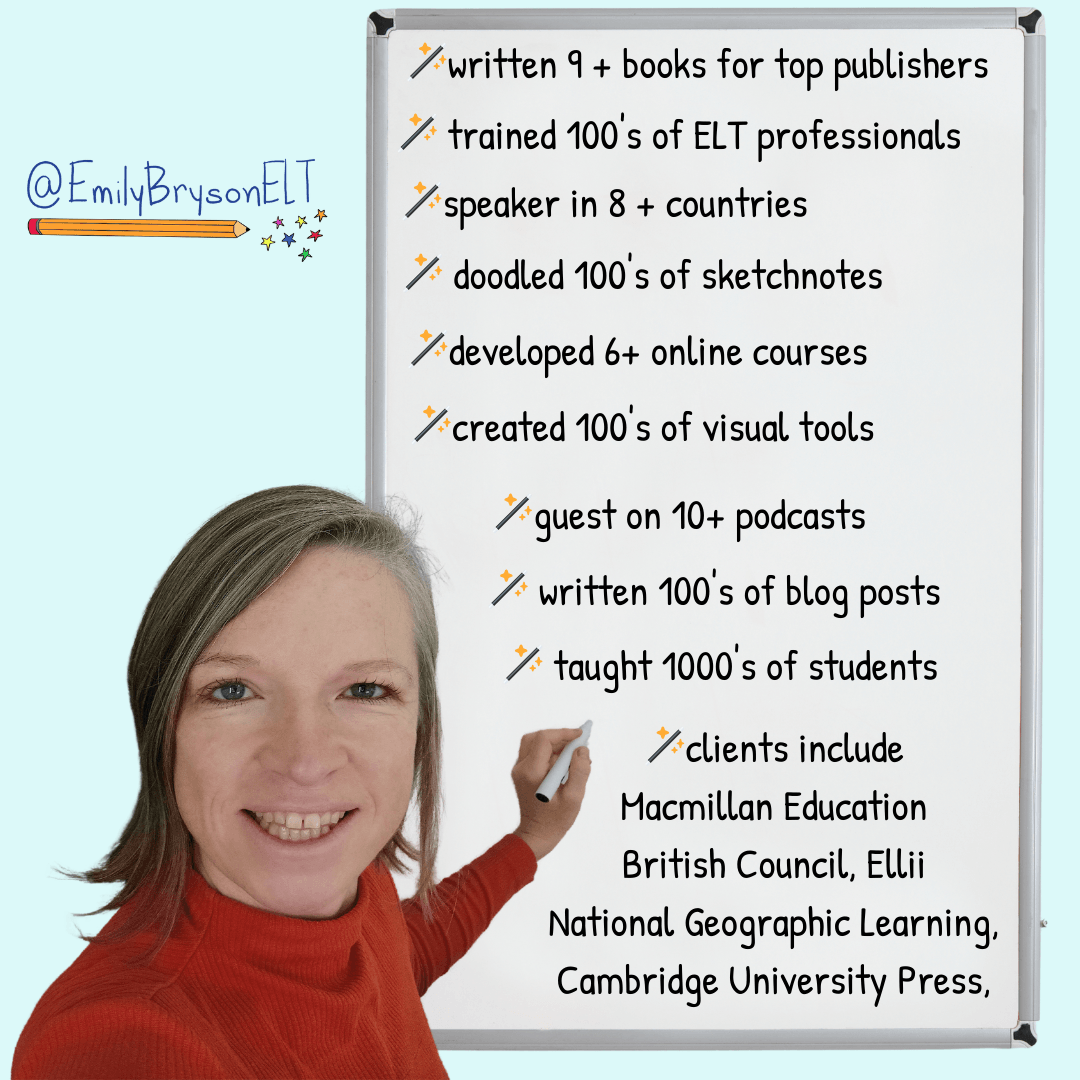
I'm Emily Bryson, an English Language Teaching Specialist who brings visual thinking sparkle to classrooms around the world.
I can help ELT Professionals and Educators with:
Teacher Development online and in-person
Visual Thinking Resource Packs for language learners
Online Courses in visual facilitation for English language teachers
Materials, Books, Blogs for the ELT classroom
FREE Guides in Sketchnoting & Graphic Facilitation for learning English
Free Guides in Visual Thinking for English Language Teachers
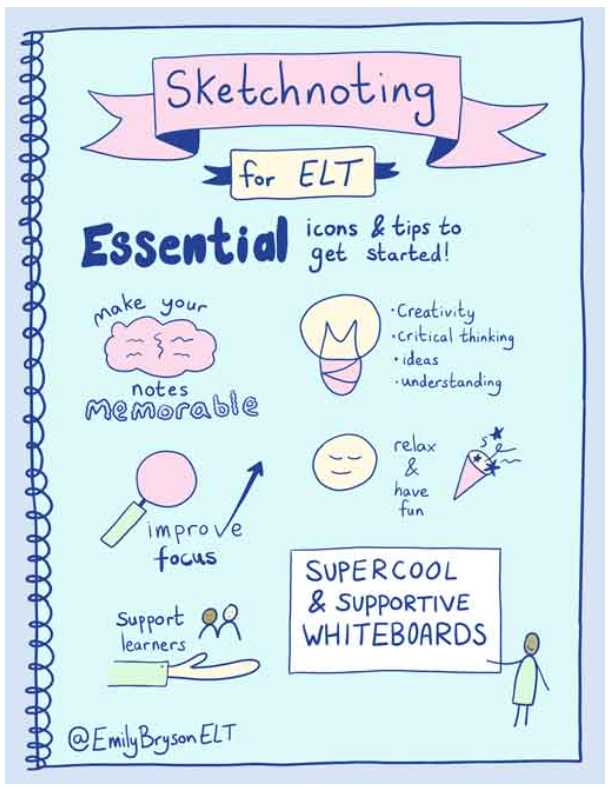

Online Courses & Resources with a Visual Twist
Designed Especially for ELT Professionals


Visual Note Taking (Sketchnoting) & Teacher Development Services for Online & In-Person Educational Conferences & Events


Leave a Comment
🪄 Visual Sparkle for English Language Learning & Teaching 🪄
Copyright © 2025 Emily Bryson ELT


