
The satisfying sounds of an engaged classroom (and how to hear them)!
How to know your learners are engaged!
There are many ways to know whether your learners are engaged. The looks on their faces, the answers they give, the questions they ask. But also the sounds that they make:
‘Aaaaah’ (I understand)
‘Ooooh’ (How cool!)
‘Haha’ (How funny! This class is great!)
Hearing students make those sounds is what we live for as teachers. It’s those moments that make you think there can’t possibly be a better job in the world.
Using Simple Shapes & Visual Thinking to Inspire Learners
So how do you hear the sounds of an engaged class? One time that stuck in my head was when I did simple listening activity using doodles.
I was teaching my beginner class and creating drawings on the whiteboard using basic shapes. We were revising common objects (e.g. a watch, a camera) with the form ‘It is a/an’.
You may have noticed that my drawings are as simple as I can make them. They are often made of squares, circles, triangles, rectangles, lines and squiggles.
If you can form these shapes, and write the alphabet, then you can draw. It is especially easy to draw common objects with these shapes.
A Doodled Listening Dictation for Language Learning
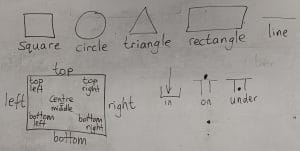
First, draw these basic shapes on the board. Then revise prepositions of place and phrases like ‘bottom left’ and ‘top right’. This is useful vocabulary for this task but also for navigating the screen in online lessons.
Then, give students a sheet of A4 printer paper and dictate the following:
Object 1: Draw a rectangle. In the centre of the rectangle, draw a big circle. In the top right corner, draw a small square. On top of the rectangle, in the top right, draw a small rectangle.
Object 1: How to draw a quick camera
Object 1: This is what they drew. One student put the square on the left, so I added another square to mine. Left or right wasn’t really important. It still looked like a camera.

Object 2: Draw a circle. On top of the circle, draw a square. Under the circle, draw a square. In the middle of the circle, draw a line. Start in the middle and go right. Draw one more line. Start in the middle and go up.
Object 2: How to draw a super simple watch

Object 3: Draw a long rectangle. On the top right, draw a small rectangle. Draw lines in the small rectangle from the top to the bottom.
Object 3: How to draw an easy toothbrush

Object 4: Draw a long rectangle. On the left of the triangle, draw a triangle. On the right, draw a small square.
Object 4: How to draw a pen in four shapes

By now, students were getting it. Drawings are just a collection of shapes. I did this with two different classes and in the second class, students got quite excited and started creating their own. Here’s what they described, with much hilarity:
Object 4: How to draw a hat, ice cream, train and rocket in class

Adaptive Teaching for Mixed Ability Classes
I did this activity with beginner classes. One group had slightly stronger listening skills and they drew as I spoke, the other needed a little more support. For them, I differentiated the activity to provide more support. To do this, dictated, then I demonstrated on the whiteboard if they needed it.
Each group made the same noises! I’d be really keen to hear if your students have the same reactions! I’d also be interested to hear how higher levels get on with this activity. I think it would still challenge them. You could read it faster, or make the objects more intricate.

If you’d like to brush up on your drawing skills and learn lots of ways to use drawing and graphic facilitation techniques for ELT, why not join one of my online courses? You can find information by clicking the laptop icon above.
Visual Thinking to Make Learning Accessible, Engaging & FUN,
I'm Emily Bryson, an English Language Teaching Specialist who brings visual thinking sparkle to classrooms around the world.
I can help ELT Professionals and Educators with:
Teacher Development online and in-person
Visual Thinking Resource Packs for language learners
Online Courses in visual facilitation for English language teachers
Materials, Books, Blogs for the ELT classroom
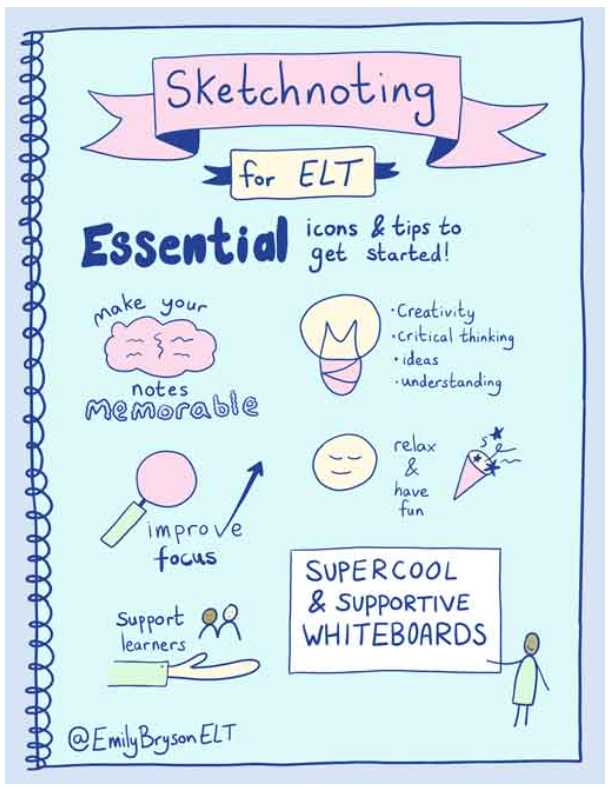
FREE Guides in Sketchnoting & Graphic Facilitation for learning English
Free Guides in Visual Thinking for English Language Teachers

Online Courses & Resources with a Visual Twist
Designed Especially for ELT Professionals


Visual Note Taking (Sketchnoting) & Teacher Development Services for Online & In-Person Educational Conferences & Events


Leave a Comment
🪄 Visual Sparkle for English Language Learning & Teaching 🪄
Copyright © 2025 Emily Bryson ELT


