
New Ways in Teaching Visual Literacy: Classroom Activities for English Language Learners
Visual Literacy Activities for English Language Teachers
I am delighted to be featured in TESOL Press's title: New Ways in Teaching Visual Literacy.
This book shares teaching techniques, tools and activities from almost a hundred expert educators in the field of English Language Teaching.
The book is published by the TESOL International Association and Edited by Lisa Hovarth and Susan Iannuzzi, it is essential inspiration for any language teacher.
What is visual literacy?
Visual literacy allows learners to successfully explore, analyse, understand, process and create a variety of visual content. For example photos, infographics, pictures, visual metaphors, icons and comics.
These abilities help learners to confidently navigate a variety of everyday tasks, such as interpreting data in a graph, understanding emotions in an illustration or considering diverse perspectives and opinions inspired by a photo.
Why is visual literacy important in the English language classroom?
Visual literacy is an essential skill. People who are visually literate can think critically about the graphic content that they encounter, process information, check facts and communicate effectively in a range of ways.
It can also help students learn more effectively. Visuals help students decode, understand and remember information. Using visual thinking techniques can also help learners create their own study materials.
What visual literacy teaching activities are included?
The New Ways in Teaching Visual Literacy book includes topics such as:
Still Images
Classroom activities in this section explore photographs and illustrations. Students can develop skills in analysing and interpreting photos, exploring images through different lenses, comparing photos and making inferences.
Videos
This part of the book shares English language teaching activities based around video content. For example, connecting audio and visual content, visual storyteling, vlogging, creating reels and creating collaborative vision boards.
Social Media
Social media plays a huge role in our daily lives. The teaching ideas here focus on meme creation, images for advocacy and deconstructing stereotypes.
Student Generated Art
In this section, students are given the opportunity to express themselves through creating their own comics, art and visual road maps.
Semiotics
Semiotics is the study of signs, symbols and how they are interpreted around the world.
This part of the book contains a variety of activities for learners to explore and discuss emojis, iconography and street signs.
Multimodalities
The educational activities in this part of the book focus on developing multimodal skills. Students can create and discuss posters, think critically about advertisements and describe mixed media.
Visualisation
The ability to visualise helps students to connect concepts, use their imagination and create plans. These activities include interpreting graphs, charts and diagrams as well as abstract concepts such as visual metaphors and note taking.
A Visual Template for Narrative Tenses
My activity is a simple hand drawn graphic to express three narrative tenses: past simple, past progressive and past perfect. It uses:
the visual metaphor of a hill on the horizon to express background information (past continuous/progressive).
two arrows, one in front of the other, to express one action happening after another (past perfect)
multiple arrows for finished actions that happened in the past (past simple.
To see it and get the teachers notes, you'll need to grab a copy!
How can I get my copy of New Ways in Teaching Visual Literacy?
You can order your paper or electronic copy of this resource here:
Visual Thinking to Make Learning Accessible, Engaging & FUN,
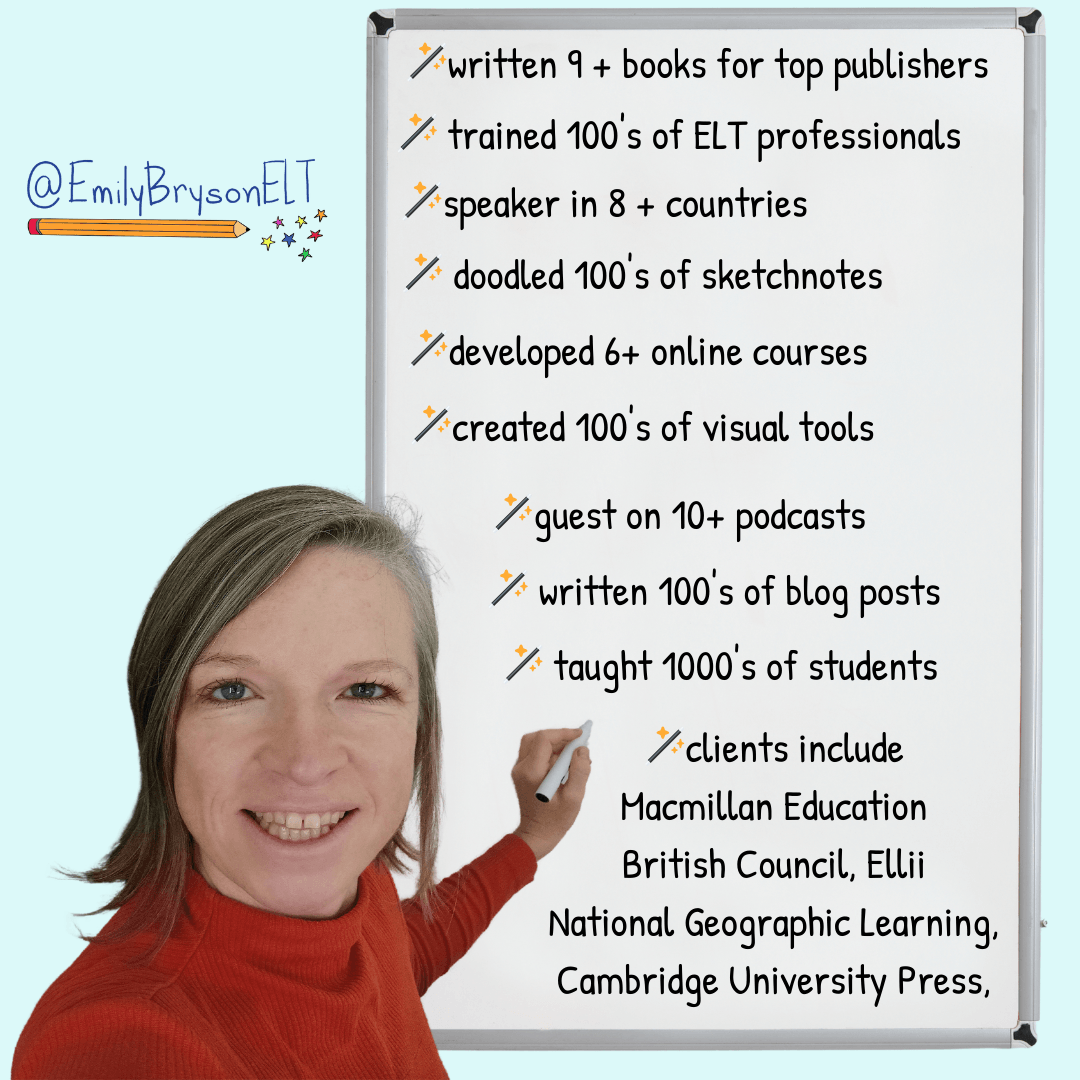
I'm Emily Bryson, an English Language Teaching Specialist who brings visual thinking sparkle to classrooms around the world.
I can help ELT Professionals and Educators with:
Teacher Development online and in-person
Visual Thinking Resource Packs for language learners
Online Courses in visual facilitation for English language teachers
Materials, Books, Blogs for the ELT classroom
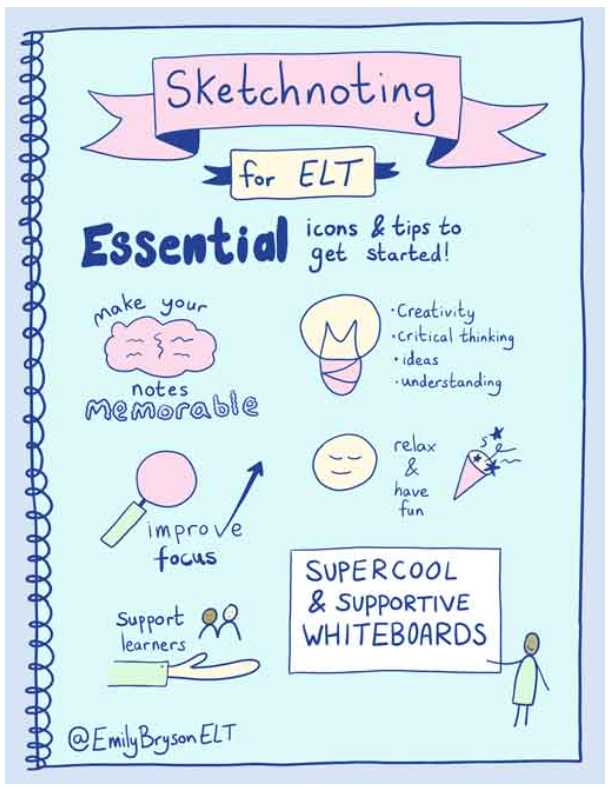
FREE Guides in Sketchnoting & Graphic Facilitation for learning English
Free Guides in Visual Thinking for English Language Teachers


Online Courses & Resources with a Visual Twist
Designed Especially for ELT Professionals


Visual Note Taking (Sketchnoting) & Teacher Development Services for Online & In-Person Educational Conferences & Events


Leave a Comment
🪄 Visual Sparkle for English Language Learning & Teaching 🪄
Copyright © 2025 Emily Bryson ELT


