
Feedback comes in many forms. But the best is a fairy!
Why feedback is so important.
Feedback is crucial for developing high quality learning experiences. As a materials writer, I value the editorial process because it helps me develop my content from first to final draft. As a teacher, I encourage my students to tell me how they feel about the content of my lessons, and what I can do to support their learning. As a teacher trainer, I am always keen to hear what participants thought of my session so I can make changes the next time I deliver it.
How to make feedback fun.
Feedback comes in many forms. Pun intended. It’s true, often feedback comes in the form of a form. Survey Monkey and Google Forms are the ‘go to’.
As a graphic facilitator, I can tell you that there are much more creative (and fun) ways of receiving feedback. In this post, I’d like to share with you to one of those methods.
Let me introduce the Feedback Fairy. She will bring visual sparkle to your classes, training sessions and events. Say goodbye to boring, tick box feedback collection. Say hello to interactive, fun and engaging visual thinking activity.
This is how I drew her in 2016, when I was first introduced to her. It took a while to draw and is quite detailed.
Once I trained as a graphic facilitator, I found a much faster, simpler way to doodle this.

Feedback Fairy, drawn by Emily Bryson.
Inspiration for the Feedback Fairy
I was first introduced to the Feedback Fairy by Martha Harding while I was on secondment at the Scottish Refugee Council. Martha had lots of cool ideas for facilitating sessions, and I added this one to my toolkit. I drew this version for the Sharing Lives Sharing Languages project that I was project managing at the time.
How to use the Feedback Fairy Visual Tool
The feedback fairy can be used in many ways. One of the most interactive is to draw on a flipchart. Then participants add sticky notes with their comments in the various sections. You can do this online using the annotation tools in Zoom or using post-its in an online whiteboard such as Canva. If you want individual feedback, you could photocopy one per participant.
Participants are guided to consider:
Heart – things they loved
Toolkit – tools, resources or activities they’d take away
Speech bubble – things they’d tell others
Brain – things they thought or learned
Wand – things they wished had been included
Bin – things they didn’t like
Some Examples of the Feedback Fairy Visual Thinking Tool
For my first cohort of Engaging Learners with Simple Drawings participants, it was a no-brainer to use the feedback fairy. But since the course focus was on graphic facilitation for English languages teachers, I did something a little different.
I asked them to draw their own feedback fairies.
I’d like to share some of them here with you. I was blown away by the creativity, skill and imagination. And how much they all loved the course!

Credit: Annette Flavel

Credit: Eve Sheppard

Credit: Nergiz Kern

Credit: Cheryl Palin
Download your Feedback Fairy Visual Template Now!
If you're not keen on doodling, I've created a downloadable PDF which you can print for participants or display on interactive and online whiteboards. I've even added a Feedback Genie and Feedback Wizard for added fun. It comes with a quick demonstration video of how to draw the Feedback Fairy yourself as quickly and simply as possible.
Find out more and download it here:

More Visual Thinking Content for Educators & ELT Professionals:
Loved this? Want to learn more Graphic Facilitation techniques specifically for ELT professionals? Start one of my Online Courses today or sign up to my mailing list.


Visual Thinking to Make Learning Accessible, Engaging & FUN,
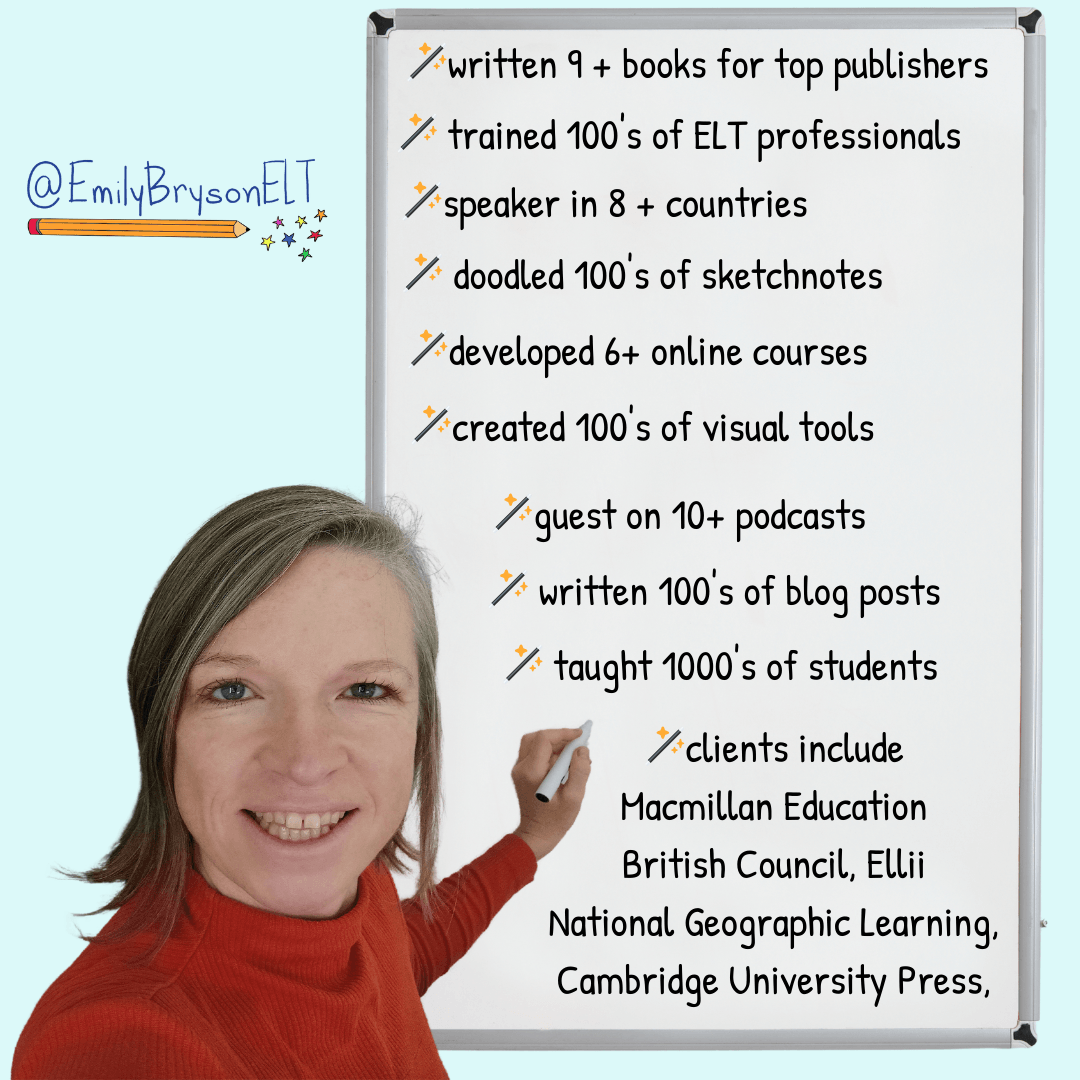
I'm Emily Bryson, an English Language Teaching Specialist who brings visual thinking sparkle to classrooms around the world.
I can help ELT Professionals and Educators with:
Teacher Development online and in-person
Visual Thinking Resource Packs for language learners
Online Courses in visual facilitation for English language teachers
Materials, Books, Blogs for the ELT classroom
FREE Guides in Sketchnoting & Graphic Facilitation for learning English
Free Guides in Visual Thinking for English Language Teachers
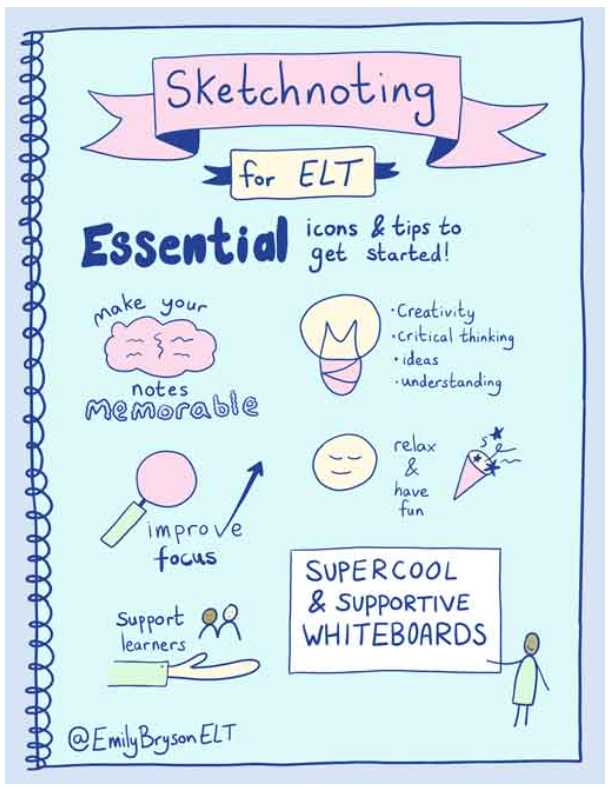


Online Courses & Resources with a Visual Twist
Designed Especially for ELT Professionals


Visual Note Taking (Sketchnoting) & Teacher Development Services for Online & In-Person Educational Conferences & Events


Leave a Comment
🪄 Visual Sparkle for English Language Learning & Teaching 🪄
Copyright © 2025 Emily Bryson ELT


