
1 Visual Metaphor: Multiple Low Prep Uses in the ELT Classroom & Context
The Hot Air Balloon & The Mountain: A Visual Tool with Many Purposes
Visual thinking uses a lot of visual metaphors and storytelling techniques to get learners thinking, talking and processing ideas.
In this blog post, I'll explore many different ways to use the metaphor of a mountain and a hot air balloon in the English language learning context.
How to Draw the Visual Thinking Tool
As with all graphic facilitation tools, this is simple to draw. On the whiteboard, flipchart or notepad, it doesn't need to be a work of art.
To draw it yourself, the mountain is essentially a triangle with jaggy lines. The hot air balloon is a circle, a rectangle, a couple of 'm' shapes and some lines.
If you're not confident with drawing, I've already hand-drawn this tool for you. So you can download it and use it by displaying it or printing it for classroom use. It is part of my Pathways to Success: Visual Tools for Goal-Setting, Self-Evaluation and Progression PDF Resource Pack for English Language Teachers.
You can also buy the individual template on Teachers Pay Teachers for $2.

1. Identifying Goals, Challenges & Moving Onwards
I have used this template in many ways, with different levels of classes. It is perfect for identifying goals in the context of employment, academia, language learning or life in general.
Have students copy the template to their notebooks (or print it). Use it as a graphic organiser to help them to think more clearly about their goals.
At the Peak of the Mountain
Use this space to have students think about their goals. Where do they want to be at the end of this course, in a year or in ten years time? If students like drawing, have them add doodles alongside their ideas.
In the Mountain
The mountain can represent challenges. As with all visual metaphors, it is open to interpretation. Students can find their own meaning.
One way to use it is to have students write things that they find difficult in this section. For example, staying focused or finding time.
Another way to use this space is to have students list steps that they need to take in order to climb to the top of the mountain and reach their goals. For example, complete a course, practice a skill or seek advice on something.
In the Hot Air Balloon
The hot air balloon represents how learners plan to reach the top of the mountain. In the weights, have students write some things that might be weighing them down, stopping them or holding them back. They want to cut these off so that they can take flight.
In the balloon itself, have them write things that will help them to fly. For example, people who can support them, positive affirmations or skills that they already have.
Emergent or Expected Language
This template can be used for a variety of different language points. In this instance, it works well with future tenses for plans. For example: I'm going to...., I will... It also works well with more complex future forms such as I wish... I hope to... I would love to... It's my dream to.
Themed vocabulary is also likely to arise, for example: achieve, enthusiastic, motivated, succeed, determined. It really depends on the topic and the individual learner. Take time to write down interesting phrases and give students time to practice using them.
Alternative Topics: Mental Health, Wellbeing & Happiness
I have used this template for many different topics. It was originally designed to explore students mental health in the trauma aware classroom.
At the top of the mountain: students write where they want to be and how they want to feel
In the mountain: students add their daily challenges.
In the hot air balloon basket: students write what makes them feel down or depressed.
In the hot air ballon: students write things, activties or people that make them feel good
Emergent language: teachers may expect learners to share activities that make them feel good, such as exercise, yoga, walking, spending time with their kids, going to the park. They may also use language related to mental health: to feel good, bad, worse, better, down. Fatigue. Tiredness. Etc.
For Personal & Organisational Use
Teachers and managers can use this template too. It is helpful to explore goals, challenges, barriers and things that help to achieve goals in any context.
On a personal level, teachers or ELT professionals can use it to plan their careers, lives or identify their business goals. I have used it to think about my own.
In staff meetings, it is a great tool to focus discussions on organisational or team goals, challanges and actions.
How would you use this graphic tool?
For more visual thinking ideas for the educational context, check out my other blog posts and content!
Visual Thinking to Make Learning Accessible, Engaging & FUN,
I'm Emily Bryson, an English Language Teaching Specialist who brings visual thinking sparkle to classrooms around the world.
I can help ELT Professionals and Educators with:
Teacher Development online and in-person
Visual Thinking Resource Packs for language learners
Online Courses in visual facilitation for English language teachers
Materials, Books, Blogs for the ELT classroom
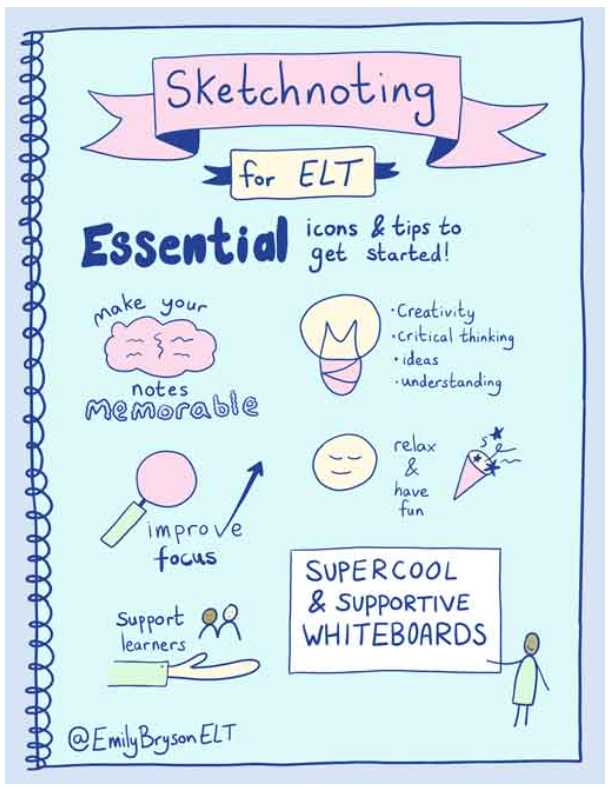
FREE Guides in Sketchnoting & Graphic Facilitation for learning English
Free Guides in Visual Thinking for English Language Teachers

Online Courses & Resources with a Visual Twist
Designed Especially for ELT Professionals


Visual Note Taking (Sketchnoting) & Teacher Development Services for Online & In-Person Educational Conferences & Events


Leave a Comment
🪄 Visual Sparkle for English Language Learning & Teaching 🪄
Copyright © 2025 Emily Bryson ELT


