
Native Speakerism: Working Towards a Fairer English Language Teaching Industry
Let's End Native Speakerism in the ELT Industry
What is Native Speakerism?
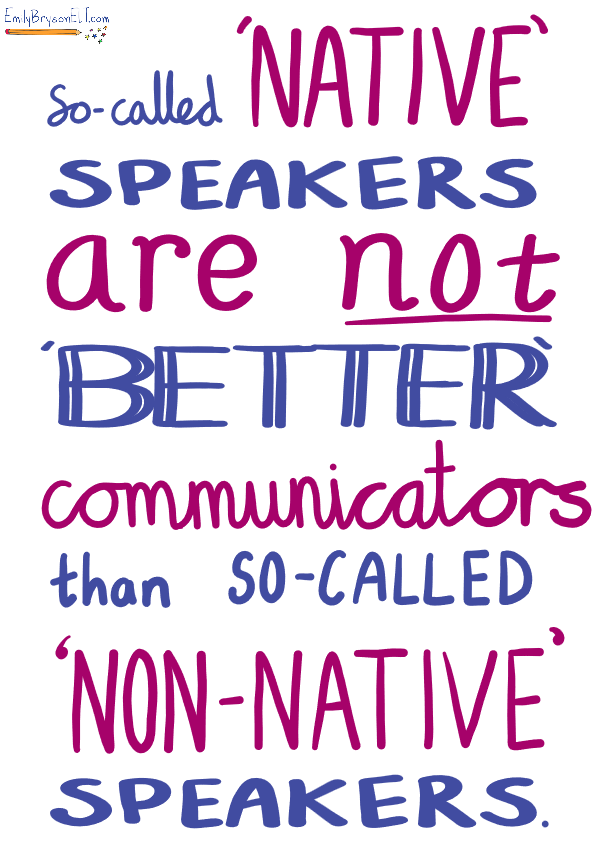
Native speakerism is the belief that so called 'native' speakers communicate better in their first language than speakers who have learned the language.
Native speakerism is rife in English language teaching. Although it's a form of discrimination, some schools still advertise for 'native' speaker teachers. And although there are 65+ countries that have English as an official language, work permits for certain countries can be restricted to teachers from places like the UK, USA and Canada - predominantly white, colonial super-powers.
Still to this day highly skilled, well-qualified, proficient 'non-native' speaker language teachers can be overlooked for work. Meanwhile 'native' speaker English language users can get hired with minimal or no training.
Influencers even use terms like 'speak like a native' as clickbait to attract viral engagement on supposedly 'educational' content. This content can perpetuate low self-esteem in learners who compare themselves to their so called 'native' speaking peers.
Are 'Native' Speakers Better Communicators than 'Non-Native' Speakers?
Nooooo. So-called 'native' speakers are not 'better' communcators than so-called 'native' speakers.
I am writing this blog post with the aim of debunking this myth.
'Native' speakers often talk far too quickly, use too many idioms, use too much slang, have unfamiliar accents and can be harder to understand. They need to learn to slow down, choose simpler words in order to communicate more effectively.
Meanwhile, so called 'non-native' speakers can speak more clearly, slowly and pronounce things with more care. They may also have developed certain skills such as rephrasing, repeating or using body langauge to express themselves.
I taught English language learners in Glasgow for many years. It won't surprise you that they could understand their 'non-native' speaker classmates more easily than the so-called 'native' speakers blethering in Scots! (blethering = talking in Scots)
Let's Smash the 'Native' Speaker Pedestal.
People often apologise to me for their level of English. Even when they are communicating fluently. It makes me sad, because they've put me on the 'native' speaker pedestal.
No one should be on that pedestal! Let's smash this pedestal.
In many ways, I'm not really even a 'native' speaker. When I started teaching (and traveling) I had to teach myself to modify my my own English (ahem, Scottish) to be understandable. I still feel bad for the first class I taught - in fast flowing Glaswegian!
So, please, can we stop this unfounded belief that 'native' speakers are top notch communicators? Communication skills are learned. And conversations take more than one person to be successful.
English belongs to everyone. There are many different ways to use it. Let's celebrate each and every diverse English usage from all around the world.
Embrace your accent. It's beautiful.
Visual Thinking to Make Learning Accessible, Engaging & FUN,
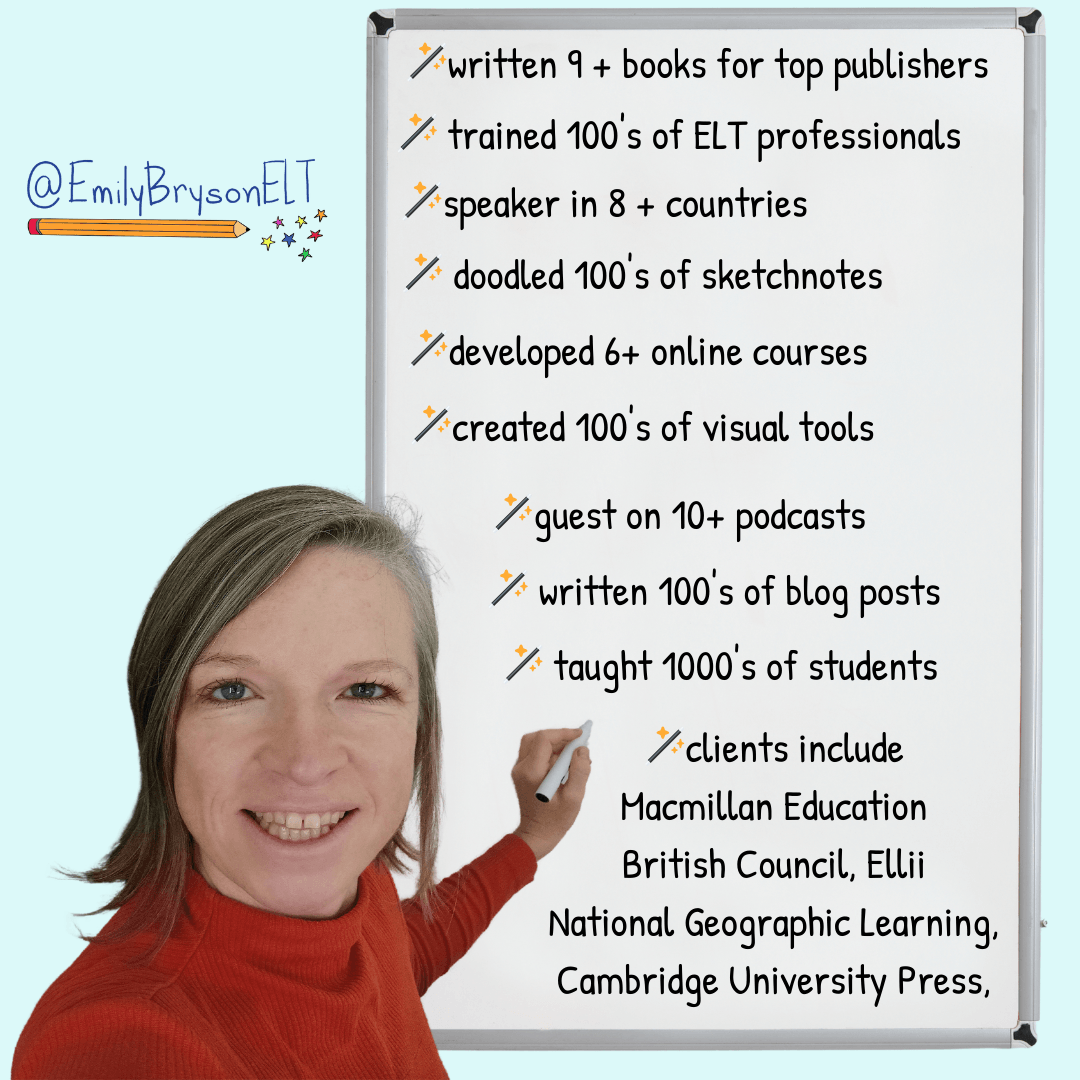
I'm Emily Bryson, an English Language Teaching Specialist who brings visual thinking sparkle to classrooms around the world.
I can help ELT Professionals and Educators with:
Teacher Development online and in-person
Visual Thinking Resource Packs for language learners
Online Courses in visual facilitation for English language teachers
Materials, Books, Blogs for the ELT classroom
FREE Guides in Sketchnoting & Graphic Facilitation for learning English
Free Guides in Visual Thinking for English Language Teachers
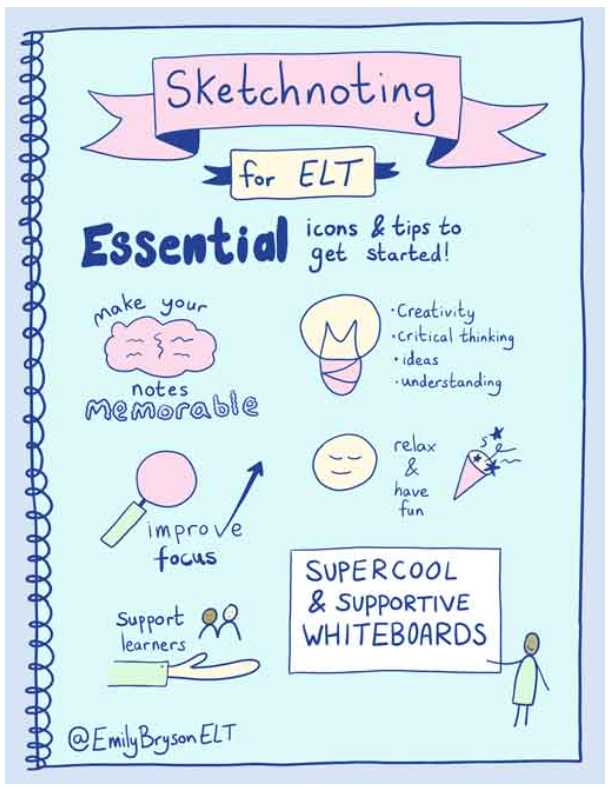


Online Courses & Resources with a Visual Twist
Designed Especially for ELT Professionals


Visual Note Taking (Sketchnoting) & Teacher Development Services for Online & In-Person Educational Conferences & Events


Leave a Comment
🪄 Visual Sparkle for English Language Learning & Teaching 🪄
Copyright © 2025 Emily Bryson ELT


