
10 principles of ESOL teaching
Updated Feb 2026
A principle is a basic theory or belief that influences how we do things. Over my years teaching English to Speakers of Other Languages, I’ve developed my own principles which influence how I teach.
Everyone is different and these are my own personal principles suited to my own teaching context. I’d like to share them with you so that you can reflect on your own principles related to your own teaching context.
1. Be learner centred
ESOL learners must be at the heart of every lesson. The social practices approach puts learners at the centre of all learning. The learning experience is co-created between the teacher and the learner, based on the learners needs. If a learner has a broken shower, for example, the teacher may deliver a lesson on how to arrange for a building repair.
Here's a little visual thinking activity to get students thinking about their needs. First, draw a quick doodle of a person (an 'n' with an 'o' on top is enough). Then draw three or four circles around them.
In the inner circle, have students write their most important needs. These are essentials for their daily life. For example, someone who is living in an English speaking country might need to speak to the doctor, their immigration lawyer or apply for a job.
In the second circle, have them make notes of things that are important, but not essential. For example, choosing the right type of milk or shampoo in the supermarket. On the outside circle, have them write things that interest them: that they want to learn rather than need to learn.
Once students have made a note of things that they want and need to learn, have them look for similarities. This can help you to choose which topics to study in class.
2. Choose REAL learning topics
The social practices approach focuses on equipping learners with the functional skills they need for their daily lives. They may need to know how to read a school report or what to do in an emergency situation.
I’ve had students that told me they phoned an ambulance because they had a bad headache, or that the fire services visited them when they used a disposable barbeque on the balcony of their high rise flat. It goes without saying that I thought it important to create a lesson on the emergency services for my book, the A-Z of ESOL. The lesson helps students assess which service they should call, which number to dial and whether they even need to call.
3. Include literacy skills development
Many ESOL students have ‘jagged profiles’. They may be confident with speaking and listening but have minimal literacy skills. Even at higher levels, I find myself reminding students to write in sentences, use paragaphs and not to forget their capital letters. At lower levels, I spend a lot of time on reading, writing, phonics and spelling.
4. Support learners to develop ICT and digital skills
We are living in a digital world yet many of my students lack confidence with computers. In some cases, they struggle to use ‘shift’ to add a capital letter or use a mouse. I’ve lost count of how many times I’ve reset the Virtual Learning Environment passwords for my beginner students, but we get there in the end. We always do.
Never give up, no matter how frustrating it may be is my mantra! If I’m in a classroom without computers, I’ll ask students to use their smartphones. This gives them the confidence to access the VLE from home. I also encourage them to find IT classes in the local community (often in the local library).
5. Encourage employability skills development
To me, employability is the 5th skill. Finding a job in an English speaking country is challenging not only because of the language barrier, but also because it can be a whole new process. In some countries, if you want to find a job you may just ask your family and friends, or go to a local roundabout where recruiters will ask around for the skills they are looking for. The idea of selling yourself on paper, identifying skills and qualities and dressing appropriately for an interview can be very alien concepts.
I had one student who went to an interview wearing their winter coat and trainers while another learner said ‘no’ when asked if she was ‘trustworthy’ simply because she didn’t understand the word. Now I teach important personality adjectives to my beginners using images and antonyms. ‘Punctual’ is a pretty simple to teach to a class full of latecomers on ‘ESOL time’. I also teach more practical jobs vocabulary; forklift driver, warehouse operative and cleaner are more useful to ESOL learners than ‘pilot’ and ‘journalist’!
6. Support study skills
I often find that the students that progress quickly are the ones that have completed high school or further education in their own country. They have the study skills to know that they are responsible for their own learning, they do their homework and they study at home.
I teach my learners how to copy notes from the whiteboard (the same as they are laid out on the board), which worksheets to keep for further reference and which ones they can use once for practice and chuck in the bin later. I encourage them to use vocabulary notebooks and encourage them to take graded readers out of the library. I also teach them the look, say, cover, write, check method to practise their spelling at home and give them homework every lesson.
I like to take photos of my students’ notebooks. I now have a collection that I can use in class to show students examples of how to (and how not to) take notes. And of course, doodling can help them to remember!

7. Help students with Intercultural communication
ESOL classes are multicultural. I can have ten or more nationalities in a room at one time so it’s essential that they understand and respect each other. I often find that students who speak the same language or are from the same country sit together. At the start of each lesson, I take a minute to encourage students to sit with someone different every day. This gives everyone an opportunity to get to know each other. I also get them chatting about their cultures and beliefs and take them on class trips to places of worship of religions that they may not be familiar to them.
8. Embrace taboo topics and global issues
Whilst coursebooks shy away from taboo subjects such as politics, religion, sex, sexual orientation, abuse and discrimination, I think it’s extremely important to include these in the ESOL classroom. Learners need to know about the politics of the area they live in, the religious beliefs of their classmates, LGBT rights and what to do if they experience abuse or discrimination. You may want to arrange a guest speaker to discuss these topics. For more ideas, you can read my blog on including LGBT+ matters in the ESOL classroom.
9. Translanguaging and Peer Support
Students love the chance to 'be the teacher'. Let them support each other in their first language. When some learners speak the same language, give them time to offer each other explanations in their first language. This lets them value their first language(s) and helps them make sure they fully understand the concepts.
I’ve also blogged about this before, but ESOL students are very lucky that their local area can be their classroom. The students that progress the most quickly are the ones that are out and about volunteering, working or attending a local club or community group. I like to use the K for Knowing local people and places lesson from my book, the A-Z of ESOL, when encouraging my learners to get involved. Students read some examples of activities in a local area before discussing what they might like to do and what opportunities are available in their local area.
In conclusion…
These are my ten principles of ESOL teaching. They influence how I teach and they inspired the lessons in my A-Z of ESOL. What are your principles?

Visual Thinking to Make Learning Accessible, Engaging & FUN,
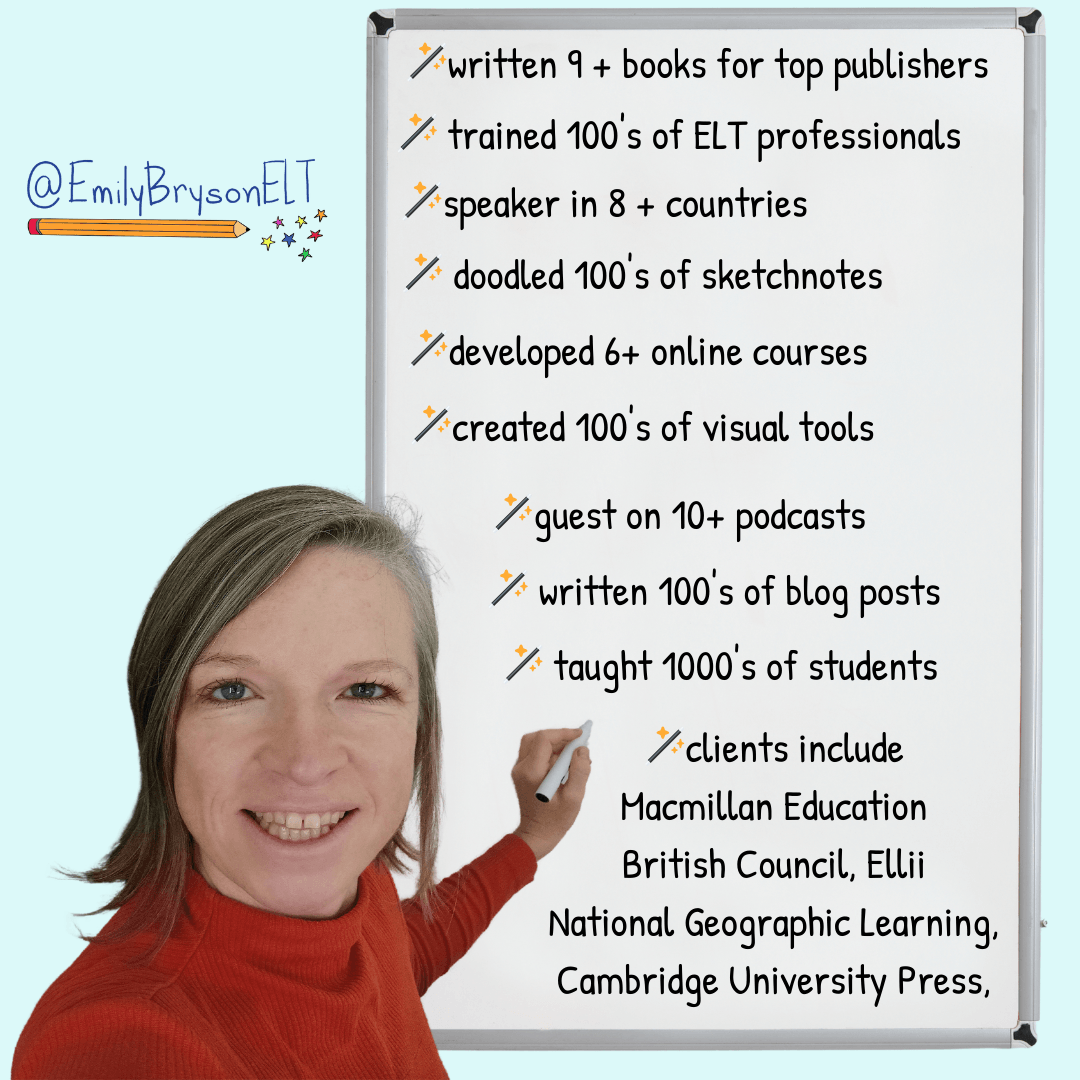
I'm Emily Bryson, an English Language Teaching Specialist who brings visual thinking sparkle to classrooms around the world.
I can help ELT Professionals and Educators with:
Teacher Development online and in-person
Visual Thinking Resource Packs for language learners
Online Courses in visual facilitation for English language teachers
Materials, Books, Blogs for the ELT classroom
FREE Guides in Sketchnoting & Graphic Facilitation for learning English
Free Guides in Visual Thinking for English Language Teachers
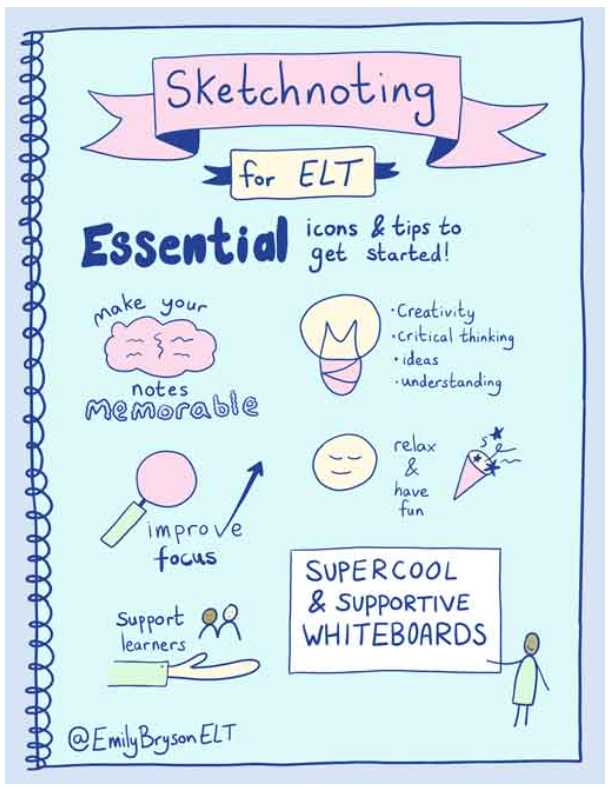


Online Courses & Resources with a Visual Twist
Designed Especially for ELT Professionals


Visual Note Taking (Sketchnoting) & Teacher Development Services for Online & In-Person Educational Conferences & Events


Leave a Comment
🪄 Visual Sparkle for English Language Learning & Teaching 🪄
Copyright © 2025 Emily Bryson ELT


